Tuesday, 31 January 2023

Dungeon23: Month 1

I've really neglected this blog. I don't have that many new zany ideas, revolutionary content, or engaging opinions, and over the last 12 months or so I've been more player than referee in a bunch of games, both OSR and not, so there wasn't much to post. However, I submitted an entry to the NoArtpunkII contest last year, and I plan on releasing it here too, in slightly more polished form, as soon as the NAP2 anthology gets published.

In the meantime, there's this neat #Dungeon23 thing I'm taking part to.
The basic idea is to draw and key a dungeon room for every day of 2023 to stay creative and active, ideally collecting it all in a journal. I'm also doing a hex a week, so at the end of the year, I'll have 12 dungeon levels of about 30 rooms each and a hexmap of roughly 50 cells of land.

So here's the first month worth of rooms, and hexes:

  1. Empty Alcoves - Trampled bones to the east
  2. Dead Adventurer - 20sp on corpse
    behind hidden door: 25gp, 50sp
  3. Cells
    a) Sack, silver dagger
    b) 1 Zombie
    c) Imprisoned Wererat, wants to get out
  4. Spying Outpost - Hidden door and spy-holes to the west
  5. Old Armory - Broken weapon rack, spear
  6. Shrine - 4 Skeletons, Scroll of Protection from Evil
  7. Rat nest - 6 Giant Rats and 1 Swarm of Rats; gold belt buckle (40gp)
  8. Lizard Lair - 8 Kobolds
    a) behind locked door: 400sp
    b) 3 Lizardfolk
  9. Unclean Lair - 1 Ogre, 1000gp, 8 gems (2x1000gp, 3x500gp, 2x50, 10)
  10. Hermitage - Ascetic (Cleric2) in meditation, Scroll of Detect Evil
  11. Looted Tomb - Empty sarcophagus
  12. Trapped Tomb - Sleep gas trap; 10 gold ingots (30gp each)
  13. Damaged Room - 500cp hidden under loose tiles
  14. Spider Nest - 1 Crab Spider
  15. Trapped Stone Idol - Flammable Gas Trap
  16. Crypt - 8 Skeletons
  17. Bear Lair - 1 Black Bear, silver necklace (10gp) (wanted by NPC party)
  18. Temple - 6 Acolytes and 1 Priest (Cleric3) performing rites, Jade Idol (1000gp)
  19. Storage Room - Crates of moldy supplies
  20. Kitchens - 5 Orcs
  21. Hideout - 11 Orcs
  22. Dank Room - 1 Yellow Mold
  23. Cursed Tomb - 3 Zombies, Scroll of Hold Portal, 200gp
  24. Dusty Tomb - Shattered bones
  25. Shrew Nest - 7 Giant Shrews
  26. Mining Warehouse - Excavation Tools, Hand axe
  27. Archeological Expedition - 5 Dwarfs
  28. Insect Nest - 12 Cave Locusts
  29. Replicant Nest - 1 Doppelganger (shaped like the dead adventurer in Room 2)
  30. Abandoned Nest - Empty cocoons
  31. Tomb with Fresco - 500gp, Sword +1, Scroll of Knock


Random Encounter Table d8

  1. 1d4 Cave Locusts
  2. 2d4 Skeletons
  3. Green Slime
  4. Panicked Swarm of Rats
  5. NPC party (Fighter2, Fighter 1, Thief1, Thief1) looking for silver necklace
  6. Doppelganger (from room 29)
  7. 1d4 Kobolds and 1 Lizardfolk
  8. 1d4+1 Orcs


Hexmap

  1. Dungeon Entrance
  2. Forest - Gem (1000gp) in pond
  3. Town
  4. Plains - Inscribed Dolmen (random MU1 spell, 1d6 chance to find)

Monday, 10 October 2022

d8: Race-as-Class! Orc

Here's something I cooked up an posted elsewhere a long time ago, but forgot to post here.

Orc

Dragon Quest
Orcs are boar-like, warmongering humanoids. At times they get employed by villainous overlords as ruthless mercenaries, other times they create their own matriarchal societies.
HD: d6
To-hit, Saves: as Thief
EXP, Prime Requirement: as Dwarf
Restrictions: Weapons, Armor and Shields as fighter
Orcs are Omnivorous and have Fine Noses, and are Accustomed to Darkness. Their society is divided in casts based on their Sexual Dimorphism.
Omnivorous: as they are used to eat almost everything, Orcs gain a +3 bonus to saves against poison.
Fine Nose: Orcs gain a +1 bonus to tracking.
Accustomed to Darkness: Orcs have Infravision, but get a -1 malus to their to-hit rolls when in daylight.
Sexual Dimorphism:

  • Male Orcs have the restrictions of a Thief, but also the abilities of a Thief of half their level, rounded up.
  • Female Orcs may either have no additional restrictions/abilities, or choose to have the restrictions of a Cleric, but also the spellcasting of a Cleric of half their level, rounded up (but no turning).

Female Orcs may advance up to level 9, male Orcs to level 8. At level 9 a female Orc becomes a Queen Matriarch and may start her own Sounder, attracting other Orcs, both male and female, under her command. A male Orc of level 8 becomes a Boarlord and may organize a Raiding Party, attracting other male orcs; an Orc Raiding Party may act as an independent mercenary company for hire, or swear fealty to a Queen Matriarch, paying a tithe but gaining reproduction rights.

Saturday, 18 September 2021

Marriage, Heirs, and Children Education

Almost a year ago I was in a brainstorming session over how to best handle families and heirs for domain level play, which resulted, among others, in this post by one of the awesome lads involved.
I too was toying with some possible mechanics on the subject, but a terrible inspiration-drought, combined with real life being the usual bitch, caused my initial draft to lie in a folder catching digital dust until recently.

So here's my take on how to get your Character married, have children, and raise a proper heir for the domain.

Courtship
Any adult character can decide to marry.

Courtship can be initiated towards any valid target at any valid time.
The initiator may try to ease their target's heart by offering expensive gifts, such as jewelry, charming pets, exotic flowers, exquisite food, battle trophies, and lavish spectacle.

A 2d4 + the initiator's Charisma Modifier is rolled to decide if the courtship is accepted, with a +1 bonus for every HD*1000gp spent in gifts, with HD being the Hit Dice of the courtship's target (10gp for Normal Humans), for a maximum bonus of +2 from gifts.

2 or less - Mockery: the initiator messes up badly becoming the laughing stock of the region, and can't attempt any courtship for a year.
3-5 - Refusal: the courtship is refused, and the same target can't be courted again for a year.
6-8 - Courtship: the initiator made a good impression and courtship begins.
9 or more - True Chivalry: the initiator made an excellent impression and courtship begins, +1 to Proposal.

Source
Proposal 

After a month of courtship, the initiator may propose.

Again a roll of 2d4 + the initiator's Charisma Modifier is made, and again gifts can be used to ease the target's feelings, with a +1 bonus for every HD*1000gp spent in gifts, with HD being the Hit Dice of the courtship's target (10gp for Normal Humans), for a maximum bonus of +2 from gifts.


2 or less - Refusal: the target is offended and refuses, ending the Courtship.
3-5 - Courtly Love: the target neither refuses nor accepts, and Courtship continues.
6-8 - Acceptance: the target accepts the proposal, +1 to Wedlock Happiness.
9 or more - A dream come true: the target accepts the proposal, overjoyed, +2 to Wedlock Happiness.

Saint Nicholas provides the Dowry for three poor virgins,
Cornelis de Vos

Dowry 

Dowry is usually paid by the family of the spouse who joins the other spouse's family household (i.e. if the marriage is patrilineal, the bride's family will pay, if the marriage is matrilineal, the groom's family will pay).
If both spouses decide to start their own household or cadet branch, then both families pay a Dowry to the newlywed.
Dowry generally consists of household furniture and tools of trade, but can also include livestock, property, land, or household staff, especially among the wealthy.
In case of a divorce, the Dowry is returned together with the divorced spouse to the family who paid it, to ensure the economical well-being of the divorced spouse.

The necessary Dowry is calculated as HDd10 * 100gp, with HD being the Hit Dice of the spouse leaving their family (or 1d10*10gp for Normal Humans).
It is possible to choose to pay the maximum possible Dowry to ensure a stable marriage, giving +1 to Wedlock Happiness

It is seen as a mark of pride to provide the dowry to a spouse whose family is not able to provide it by themselves: paying a dowry for someone else gives the patron a +1 bonus to all reaction rolls in the area for a year.


Wedlock Happiness, Marriage Crisis and Divorce

Source

Wedlock Happiness represents the stability of the marriage, and influences the outcome of Marriage Crisis.
Wedlock Happiness increases by 1 for every 10 years without a Marriage Crisis.

A Marriage Crisis happens whenever something that could endanger the marriage happens: absence from the spouse for over a year, infidelity, death of a child, a spouse nearly dying (or dying and being resurrected), and more.

The outcome of a Marriage Crisis is determined by rolling 2d4+Wedlock Happiness.
2 or less - Divorce: the marriage ends abruptly and badly, and the spouse leaves, possibly taking any child not of age with them; both spouses get a -2 to all reaction rolls when interacting with people in the area.
3-4: Disfunctional Marriage: the marriage does not work and everyone can see it; -2 to Wedlock Happiness.
5-6: Disagreement: the spouses are not able to find an agreement; -1 to Wedlock Happiness.
7-8: Reconciliation: the spouses are able to find an agreement; the Marriage Crisis is averted.
9: Loving reconciliation: the spouses are able to find an agrement and love is rekindled; the Marriage Crisis is averted, +1 to Wedlock Happiness.

Die Hoffnung, Gustav Klimt
Conception and Pregnancy

A healthy, well-fed, non-adventuring human has a 1-in-4 chance each day to be fertile. Dwarfs and elfs are fertile 1-in-6 times, hobbits 1-in-3.
Adventurers put their bodies and minds under great stress, so while adventuring the chanches are 1-in-6 for humans, 1-in-8 for elfs/dwarfs, and 1-in-4 for hobbits. Not adventuring for 6 months is enough to recover from the adventuring stress.
Lamb intestine condoms and herbal teas drop the chance of pregnancy for the user to 1 in 20.

For each night the spouses spend together, the referee rolls the appropriate dice: on two 1s, conception happened.

Pregnancy lasts for 9 months and is divided into 3 trimesters (dwarfs and elfs have longer pregnancies lasting 12 months, divided into 3 quadrimesters).

1st Trimester - During the first phase of the pregnancy a person may experience nausea, fatigue and dizziness: the dexterity score is temporarily reduced by 1. At this time it is possible to interrupt the pregnancy with the use of herbal teas.
Taking over 3/4 total HP in damage during this phase has a 2-in-6 chance to end the pregnancy.

There comes Papa, by Raja Ravi Varma

2nd Trimester - In the second phase of pregnancy, the symptoms are less severe, and others will be more careful when dealing with the mother-to-be, who gets a temporary +1 to reaction rolls. However, the bulk of the pregnancy counts as a light encumbrance. Attempting to interrupt the pregnancy at this time is risky, and if done a save vs Death must be made: on a success, the pregnancy continues and 1d6 damage is suffered; on a failure, the pregnancy ends and 1d6 damage is suffered. Taking over 1/2 total HP in damage during this phase has a 2-in-6 chance to end the pregnancy.

3rd Trimester - The last period of pregnancy is the most intensive: the mother-to-be counts as medium encumbered and suffers a -1 to dexterity until the end of the pregnancy, but retains the +1 to reaction rolls until delivery. Any attempt to interrupt the pregnancy at this point is extremely dangerous, and a save vs Death must be made: on a success, the gestant dies; on a failure, the pregnancy ends and 2d6 damage are suffered. Taking over 1/4 total HP in damage during this phase has a 2-in-6 chance to end the pregnancy.

At the end of the pregnancy, a child is born: 1-3 on a d6 means it's a girl, 4-6 a boy.
There's a 1% chance that a pregnancy produces twins.
Soon after birth, a newborn is hallowed and their birth sign is determined.

Child Education

Children can be either educated by a parent or relative, in which case they have a 3-in-6 chance of becoming the same class of their educator instead of normal human, they can be sent into apprenticeship, where they have only a 1-in-6 chance to gain a class but learn a trade, or they can be tutored by a learned scolar, in which case their future class depends on the kind and length of their education.

A child raised by a generic educator rolls 3d6 for their ability scores, and their education is considered complete at 15 years of age. If they gain a class, their main attribute becomes 9 if it is lower than that, and they will start at level 1.

Geography Lesson, by Eleuterio Pagliano
Children tutored by skilled teacher roll 4d4, and their scores may improve during education! Their education usually starts at age 8 and proceeds up to the age of 16. At the end of their education, their main attribute becomes 13 if it is lower than that, while their level depends on how successful their education was.

In both cases, ability scores are rolled at the end of the education, then eventual bonuses are added, and them they are adjusted.

There are 4 types of education: Martial, Skill, Spiritual and Arcane. For each area there's 3 different kinds of educators.
For a name-level character who established a keep or base of some sort, there is a 1-in-6 chance each season that a random learned individual will offer their service.
It is also possible to search for an educator in one field of education once per season: a d12 is rolled, and if the result is lower than the HD of the searcher, a random educator in that field is found.
Both if the educator was searched for or presented themself, a reaction roll is necessary to employ them.

Each field of education has a main attribute that might raise with time and luck.
Each educator has a monthly cost, a special ability they will teach their warden, and a secondary attribute they may improve.

  • Martial Educators - Class: Fighter - Main attribute: Strength
    1. Huntmaster - Monthly Cost: 500gp - Perk: +1 to track, hunt and forage - Secondary attribute: Dexterity
    2. Marshal - Monthly Cost: 750 - Perk: +1 to hierling morale - Secondary attribute: Charisma
    3. Engineer - Monthly Cost: 1000 - Perk: +1 to find secret doors - Secondary attribute: Constitution 
  • Skill Educators - Class: Thief - Main attribute: Dexterity
    1. Treasurer - Monthly Cost: 500gp - Perk: 3-in-6 to correctly apprise treasure - Secondary attribute: Charisma
    2. Saboteur - Monthly Cost: 750gp - Perk: +1 to disable traps - Secondary attribute: Constitution
    3. Spymaster - Monthly Cost: 1000gp - Perk: +1 to move silently and hear - Secondary attribute: Intelligence
  • Spiritual Educators - Class: Cleric - Main attribute: Wisdom
    1. Ascetic - Monthly Cost: 250gp - Perk: halved need for food, water and sleep - Secondary attribute: Constitution
    2. Chaplain - Monthly Cost: 500gp - Perk: create 1d2 Holy Water once a week - Secondary attribute: Charisma
    3. Mystic - Monthly Cost: 1250gp - Perk: +2 languages - Secondary attribute: Strength
  •  Arcane Educators - Class: Magic-User - Main attribute: Intelligence
    1. Sage - Monthly Cost: 500gp - Perk: gain 1d3 rumors monthly  - Secondary attribute: Wisdom
    2. Völva - Monthly Cost: 750gp - Perk: prophetic visions once a month - Secondary attribute: Charisma
    3. Alchemist - Monthly Cost: 1500gp - Perk: create 1d2 Acid once a week - Secondary attribute: Constitution

Every year that a child is tutored, there is a chance to improve (or lower) the attributes of the child, determined by a 2d6 roll:

2 - An insolent rascal: The educator leaves, covered in dung, pitch and feathers; all successive educators will know of the accident and get a -1 to their employment roll
3 - A dull child: The child does not learn, and their main attribute lowers by 1
4-5 - The cost of knowledge: Education continues, but learning materials must be financed, doubling the educators cost for a year
6-8 - A decent student: The education continues
9-10 - A smart student: The education continues with good results, raising the child's main attribute by 1
11-12 - A brilliant student: The education continues with excellent results, raising the child's main and secondary attribute by 2 and 1, respectively.

For every 2 years of uninterrupted and successful tutoring (6+ on the roll), the child will gain a level upon completion of the education.

Graduation, by Dendrono

Tuesday, 30 March 2021

d12 based Thief Skills

d100s are great to choose from big tables when stocking dungeons, picking names, and other such leisure.

But I don't like d100 Thief skills.
I'm a simple person, and rolling more than one die during play gets on my nerves as soon as it goes beyond simple "add the numbers together" or "pick the bigger/smaller number".
My players don't like d100 skills either.

There's been a lot of talk about Thief skills on many forums and blogs, and many alternatives can be found, from minimalist ones, to clusterfucks that make my head spin, to everything in between.

Here's my attempt at fixing it, inspired mostly by how AS&SH does it:

This table hits the sweet spot between lots of numbers, but not too many, and they are arranged in a way that at every
level there is an advancement somewhere. Also it looks like a castle wall and I like to imagine a tiny thief climbing it.

The skill check is resolved with a d12 roll + dexterity modifier, except for the Listen skill, which does not add any modifier. The skill succeeds if the result is equal or higher than the number in the table.


Saturday, 2 January 2021

d8: Dungeon! - Greyhold Dungeon


by Axebane

I haven't been very active for a while because of real life business, but recently one of the lads posted this neat little blank dungeon by Axebane in the forum, so I gave it a shot at filling it out.

1. Shimmering Cave
This grotto shines with glowing crystals and luminous shrooms. In the pool at the middle of it lives a vain Giant Crab wearing 500gp in gold, gems and jewels on its back. Fighting in here incurs a malus of 2 to hit because everything is so shiny.

2. Greyneck's Hole
An elderly Wererat enjoys his retirement here with his wives, two Giant Rats, and his Swarm of Rats children. He dislikes visitors and will point them to 3 and 4 to get rid of them.

3. Wet Cellar
A Green Slime hangs from the ceiling of this damp, stinking, empty room. Behind a fake wall is a small room containg 600sp, a scroll of poison spell, and a book about poisons (studying the book daily for a month gives a permanent +1 to saves vs poison).

4. Old Catacomb
A dusty old crypt. Inside the closed stone tomb 3 Ghouls are trying to rest among chewed bones. One of the ghouls wears a ring worth 200gp.

5. Digging Site
This room has an uneven floor, as if someone had been digging randomly in the dirt. Behind a secret door is a trapped chest with 1000gp: removing more than 100gp in weight causes the hidden alcove to collapse.

6. Storage Room
Opened crates of old supplies have been abandoned to rot here. Among the garbage are an axe and 4 flasks of oil.

7. Cave System
2 Carrion Crawlers are feasting upon the bodies of three humanoids. There's a +1 Helmet among the wastes on the floor.

8. Snail Garden
A sophisticated Flail Snail, lives here, tending to her mushroom garden and reading frivolous books. She is more than happy to trade some of her rare alchemical shrooms for romantic novels, lady magazines, or even just a few hours of tea and chatter. 

Random encounter table:

  1. 4 Gnomes, equipped with shovels, pickaxes, and drills.
  2. A Ghoul, disturbed by unscheduled excavation noises.
  3. A Giant Rat with her Swarm of Rats nephews, bringing a book to the snail.
  4. A confused Berserker, who lost his axe somewhere and will pay 50gp to have it back.

Monday, 2 November 2020

d8: Race-as-Class! (x2) - Morlock & Eloi

Two simple classes inspired by a bunch of old movies I saw recently.

Morlock

Morlocks are cruel underground creatures who dwell in absolute darkness and have an inborn proficiency with machinery.
They are short, pale and hunched, covered in patches of shaggy white fur, and their eyes glow faintly in the dark.
HD: d6
To-hit: as Thief
Saves: as Dwarf
EXP: as Fighter
Prime Requisite: Constitution
Restrictions: Weapons as Dwarf, can't use heavy armor, max 13 Charisma.
Morlocks see in absolute darkness as if it was daylight and posses Uncanny Engineering skills, but suffer from Heliophobia.
Uncanny Engineering: a Morlock is able to deduce the purpose and functioning of mechanical objects 2-in-6 times, repair and use machines of which they knows the workings, and use war machines. At 3rd level, a morlock can use Wands, Staves and Rods as a Magic-User, and at 9th level a Morlock can build an engine to cast Charm Person on up to 30 individuals within a mile once every two months.

Virgil Finlay

Heliophobia: a Morlock is effectively blinded as long as exposed to light brighter than a candle, suffering -4 to hit and -2 to all saves, and being unable to use their Uncanny Engineering abilities.
At level 9 a Morlock becomes an Ubermorlock and may found their own underground empire in a cavern system below ruins of some long forgotten civilization, and will attract other Morlocks, Carnivorous Apes, and other malevolent underground dwellers.


Eloi

Eloi are small humanoids with stunted emotions and latent psychic powers who live in primitive hunter-gatherer communities.
They are slender and attractive, but appear absent-minded and are easily distracted.
HD: d6
To-hit: as Thief
Saves: as Elf
EXP: as Fighter
Prime Requisite: Dexterity
Restrictions: Weapons as Halfling, can't use medium and heavy armor, max 13 Wisdom.
Eloi have Genetic Memory and are Latent Psychic, but suffer from Nyctophobia.
Genetic Memory: an Eloi can understand the general meaning of any written text 2-in-6 times, and will recognize and understand spoken words after having read them.
Latent Psychic: an Eloi can sense basic emotions (like anger, happiness, fear) of nearby creatures. At 3rd level, an Eloi can cast ESP once daily as a Magic-User of same level.
Nyctophobia: an Eloi exposed to light less than that of a torch panics as if affected by a Fear spell, and is unable to use their Genetic Memory or Latent Psychic abilities.
At level 9 an Eloi becomes a Luman and may establish their own tribe among the ruins of some long forgotten civilization, and will attract other Eloi, Time Travelers, and others who flee civilized society. 

Sunday, 27 September 2020

d8: Dungeon! - Vulture Spire

 
Selime Monastry

A small vertical dungeon.


1st Floor

A - Entrance
A small opening leads into these dark and cool corridors cut into solid rock. The northern one ends in a shaft going all the way upwards for 100ft; in sunny days it's possible to spot some light shining in at the top of it. The eastern passage has a shaft too, but, from below, it looks like it leads nowhere.

B - Gnome Camp
A band of 8 Gnomes and their weird, long-necked Wood Golem beast of burden are camped in this small room. They are treasure hunters and well equipped with grappling hooks, drills, shovels, and other tools of the trade.
Their current hoard, 250gp, half a dozen silver ingots each worth 200sp, as well as 3 gems worth 50gp each, is stored behind a secret door in front of which they stacked their luggage.

2nd Floor

C - Maw Passage
The walls and ceiling of this tunnel are decorated with gaping, fanged maws carved into the rock. Everyone dwelling here more than 3 rounds must save vs Spell, or start to notice that the maws are twitching when not observed directly. This is however only a magical suggestion, the maws are actually immobile. The door to D is stuck.

Codex Tudela

D - Chapel of the Hunger
The walls of this chamber are painted with unsettling scenes of cannibalism. Two monstrous stone statues stand close to the walls, and opposite to the door there is a grim, skull shaped altar. The statues are actually 2 Gargoyles, patiently waiting for victims. There's a shaft going up between the statues, while the floor in front of the altar is trapped in such a way that for every person on the platform, there is a cumulative 1-in-6 chance that a trap door will activate, with anyone standing on it falling 20ft down into A and suffering 2d6 points of damage. The altar has a hidden hollow section inside holding a fanged Crystal Skull worth 500gp, a Ring of Floating Disc with 4 charges, a Crystal +1 Dagger and a Bag of Devouring.

E - Traitor Cell
The western end of this small filthy cave opens to the outside and drops downward for some 30ft, but it was closed by a crude palisade, while on the east, a shaft goes up.
A single miserable, crippled Harpy dwells here, barely kept alive from the scraps dropped from above. She can't fly anymore, has only 3HP left, and if forced to fight, does so at a -2 penality.

3rd Floor

F - Cell Complex
This hallway is dirty, dark and smells terrible. On the west, a shaft goes 20ft down to E, while the south-east one goes down 20ft to D. The door to G is stuck.
Two of the cells, F2 and F3, are empty save for piles of rotting garbage, while F1 holds a single half-starved prisoner, a blinded human. He has completely lost his sanity and babbles deliriously.


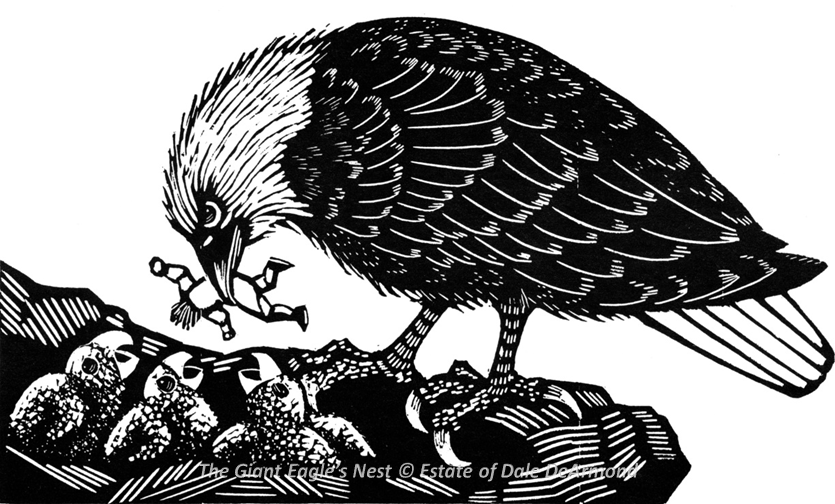
Dale DeArmond
G - Eagle Nest
The western side of this bone-littered cave is open and drops down 60ft.
A Giant Eagle has built its nest here, and is brooding its 3 eggs. It will attack if disturbed, but will not pursue intruders.
Among the bones there is a Ring of Spell Turning, and there is a fist-sized ruby with a value of 2000gp in the nest. The large, ostrich-sized eggs can be used as food, each one feeding 6 people for a day, or sold to an animal tamer.

4th Floor

H - Windy Tunnel
This carved tunnel is slippery with bird droppings and reeks terribly. Cold wind flows through it constantly. The doors to J are unlocked.

I - Hatchling Crib
One side of this room is open and drops down 90ft into the void. 8 Infant Harpies (stats as harpy, but have only 1HD and can't sing yet) are kept in this room, and make an awful lot of noise playing and fighting each other among their own wastes for food and entertainment. 7 chewed ingots, each worth 50gp, are half-buried in the filth.

J - Larder
15 Giant Locusts are held captive in this small room and fed scraps. Should both doors be open at the same time, the insects will attempt to flee and scatter around.


K - Court of the Vulture Queen
Harpies by Donna Barr - Source
Multiple crude nests are in this wide room. The biggest nest is occupied by the Harpy Queen (stats as harpy, but has HP and fights as a 4HD monster), and she is "attended" by 5 Harpies. They all "wear" tattered shreds of fine garments and pieces of jewellery they stole from their victims. Most of it is utterly ruined, but there's a total of 300gp worth of gold thread woven into the cloth, and each harpy has 100gp of golden rings, trinkets and chewed coins woven into their feathers. They don't care about noise from other rooms, but will attempt to charm intruders they spotted by singing and lure them off the open side of the room, letting them fall down 90ft for 6d6 points of damage. Should anyone resist their song, then they will attack and pursue.


Random encounter table:

  1. 1d4 Giant Locusts (2d4 if the ones in J escaped) jumping around
  2. A Harpy soiling her surroundings
  3. 1d3+1 Giant Geckos out for a hunt
  4. A Green Slime dripping down from the ceiling
  5. 3 Gnomes inspecting some rock samples

Factions, Interests, Conflicts:

  • The Gnomes are a greedy bunch, and will try to scam others if they believe they can get away with it. However, they could be convinced to part with some of their equipment, or even to collaborate for a while, if paid in pure gold or gems.
  • The Harpies are an airheaded, chaotic anarchy barely kept together by their queen, who has no problem chomping off fingers or whole wings to hold the others in check. They are pretty much incapable of long term planning, and are only concerned with finding new prey or temporary lovers (there's no real distinction for them). They are easily distracted by shiny objects like coins and mirrors, or colorful fabrics, and there's a 2-in-6 chance they will interrupt whatever they were engaged with and fight among themselves over it.
  • The crippled Harpy was mangled and imprisoned by the others for not wanting to share her latest toy, and hates them for it. She has, somehow, gained awareness that she would not stand a chance against anything bigger than a rat, and could, maybe, be willing to share information about the others in the hope of getting them killed.
  • The blind prisoner had his eyes ripped out by a harpy, and was at some point thrown into the cell, more by mistake than on purpose. He babbles deliriously, his mind long gone, calling for his beautiful darling who stole his eyes and heart.